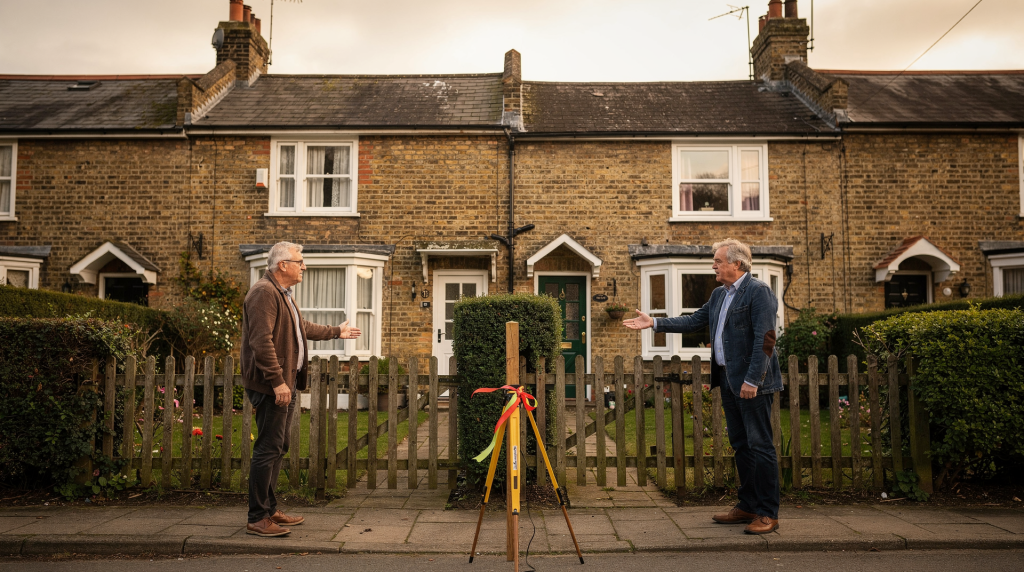
A neighbour’s new fence, an overgrown hedge, or a strip of driveway that suddenly feels narrower than it used to be — boundary disputes rarely begin with a dramatic confrontation. More often, they creep up quietly until one day you realise you and the person next door have completely different ideas about where your land ends and theirs begins. In my experience, the most effective first step is not to argue about who is right, but to gather the legal documents, compare them with the physical reality on the ground, and try to resolve the issue early and calmly.
What a boundary dispute actually is
A boundary dispute arises when neighbours disagree about the exact line dividing two properties, or about who is responsible for a feature on or near that line. In legal terms, it’s not just a squabble over a few inches of soil — it’s a disagreement about the extent of each owner’s title and the obligations attached to physical features along the boundary. Common flashpoints include fences, walls, trees, extensions, sheds, paths, and access strips.
In England, the key point is this: a Land Registry title plan usually shows general boundaries, not a precise legal line. That means the red line on the plan is helpful, but it is not enough on its own to settle a dispute. I’ve seen countless clients wave a title plan at a neighbour, convinced the red line proves their case, only to discover later that the plan is merely a rough guide based on Ordnance Survey mapping and doesn’t determine the exact boundary.
The first legal step: check your documents
Before you say anything to your neighbour about rights or make any demands, sit down with the paperwork for your property. This is the foundation of any boundary analysis. The documents will tell you what was intended when the land was divided or transferred, and they often contain clues that a simple title plan cannot provide.
Documents to look for
- Title register
- Title plan
- Transfer deed or conveyance
- Old deeds and historic plans
- Your purchase pack from the conveyancing process
- Any planning drawings or survey plans that mention the boundary
If you’ve mislaid any of these, you can obtain official copies from HM Land Registry for a small fee. It’s also worth comparing your neighbour’s title documents, because one set of papers may contain details missing from the other — for example, a ‘T’ mark indicating who is responsible for maintaining a fence. I often suggest clients download their neighbour’s title register and plan from the Land Registry’s website; it’s a public record and can be done in minutes.
What to look for in the paperwork
- Measurements or dimensions — rare but valuable
- Marked features such as walls, hedges, or fences on a plan
- “T marks” showing maintenance responsibility — small inward‑pointing ‘T’ symbols on a plan are particularly important
- Words such as “along the hedge line” or “to the rear of the wall” — these can be more helpful than a simple red line
- Historic changes that may explain why the current feature does not match the plan — a conveyance from 1960 might refer to a hedge that no longer exists
Why the title plan is not enough
A common mistake is assuming that the red line on the title plan proves the exact boundary. It does not. In most cases, the title plan only shows the general boundary based on Ordnance Survey mapping. I often explain to clients that the Land Registry’s own practice is to show general boundaries only, unless the property is registered with a determined boundary — which is rare. So if you’re relying solely on the title plan, you’re building your case on sand.
That matters because:
- the red line may sit slightly inside or outside the real boundary
- physical features can move over time — a fence might have been repositioned decades ago
- old boundaries may have been altered without a proper update to the register
- a fence can be a practical boundary marker without being the legal boundary
If the issue is important enough to affect ownership, building work, or access, you need more than the plan alone.
Step 2: inspect the property carefully
Once the documents are in hand, compare them with what is actually on the land. This is where you put the paperwork to the test. A physical inspection can sometimes resolve the matter on the spot — I’ve seen cases where a neighbour’s concern was based on a misunderstanding of where the boundary feature actually sits, and a joint walk with the documents in hand cleared it up without any formal steps.
Check these points on site
- Where the fence, wall, or hedge actually sits — is it a straight line or does it wander?
- Whether the feature looks original or recently moved — fresh concrete, new posts, or disturbed soil can be telling
- Whether neighbouring features line up consistently — does the line of fences or walls make sense across several properties?
- Whether there are signs of historic occupation or use — old fence posts, changes in paving, or a line of mature shrubs can tell a story
- Whether one neighbour has maintained the feature for years — who has been painting, repairing, or planting along it?
- Whether the disputed area is being used as part of a garden, driveway, or side passage — actual use often reflects the parties’ understanding over time
A practical site check often reveals whether the disagreement is about a true boundary problem or simply about maintenance and ownership expectations.
Step 3: talk to your neighbour early
The quickest and cheapest disputes are often resolved by a calm conversation before positions harden. I know it can feel awkward, but a direct, friendly approach is almost always better than letting suspicion fester. I’ve seen too many disputes spiral because one person took down a fence in the middle of the night, thinking they were within their rights. That almost always backfires. The law expects you to act reasonably, and a unilateral move can be seen as trespass or even criminal damage.
How to approach the conversation
- Stick to facts, not accusations — say “I’ve noticed the fence sits here, and my deed mentions a hedge line” rather than “you’ve stolen my land”
- Bring copies of the documents — not to wave them in their face, but to show what you’ve found
- Explain what you have discovered and ask what they have — they may hold a document you’ve never seen
- Avoid moving fences or removing structures before discussion — that can escalate things fast
- Keep the tone practical and non-confrontational — you’re trying to solve a puzzle together
If a face-to-face discussion is awkward, write a polite letter or email. A clear written note is often better than a heated exchange at the garden fence, and it creates a record at the same time.
Step 4: keep evidence from day one
If there is a real dispute, start a file immediately. Good records matter because boundary disputes often depend on small details and long timelines. I always tell clients: if it isn’t written down, it didn’t happen. A contemporaneous note of a conversation can be invaluable if the dispute later goes to court.
Save these items
- Copies of all title documents
- Dated photographs of the boundary and nearby features — take them from different angles and in good light
- Emails, letters, and texts with the neighbour
- Notes of conversations, including dates and times
- Any old sale particulars or estate agent photos — they may show the boundary as it was years ago
- Surveyor reports or site notes
- Planning or building documents if an extension is involved
When a surveyor can help
If the documents are unclear, a chartered surveyor with boundary experience can review the evidence and give an informed view. A surveyor will not magically “decide” the legal boundary — that’s ultimately for a court or agreement — but their analysis can help identify where the boundary most likely lies. I often recommend a joint instruction of a surveyor, so both sides share the cost and the report is seen as neutral. That can pave the way for a sensible compromise.
A surveyor is especially useful where:
- historic deeds are unclear
- several plans conflict
- there has been a moveable fence line over time
- a recent building project is involved
- both neighbours have strong but different views
Mediation should come before litigation
In England, court action is usually a last resort. Boundary disputes are often expensive, and the cost can quickly exceed the value of the land in question. I’ve seen cases where a day of mediation achieved what two years of correspondence could not — and at a fraction of the cost of a trial.
Mediation can help because:
- it is usually faster than court proceedings
- it keeps the discussion structured
- it may preserve neighbour relations
- it can produce a practical compromise, such as a boundary agreement or maintenance arrangement
Even if full agreement is not reached, mediation can narrow the issues and save money later.
A practical first-response checklist
Use this checklist as soon as a boundary problem appears.
- Obtain your title register and title plan from HM Land Registry.
- Dig out your transfer deed and any historic deeds.
- Walk the boundary and compare what you see with the documents.
- Take clear, dated photographs.
- Have a calm conversation with your neighbour.
- Ask to see their paperwork and hear their perspective.
- Look for any mention of maintenance responsibility in the deeds.
- If things are still unclear, consider instructing a chartered surveyor.
- Before thinking about court, explore mediation.
- Never move or remove a boundary feature without legal advice.
Common mistakes to avoid
Boundary disputes often become harder because of avoidable errors. I’ve seen clients make all of the following mistakes at one time or another. The most common is the belief that the Land Registry plan is definitive. It’s an easy trap to fall into, but once you understand the concept of general boundaries, you’ll approach the problem with a clearer head.
Mistakes that make things worse
- Treating the Land Registry plan as exact proof — it isn’t
- Removing or altering a fence before the legal position is clear — this can backfire badly
- Ignoring older deeds because they look outdated — they often hold the key
- Assuming long use automatically proves ownership — adverse possession has strict rules
- Relying only on memory or oral statements — get it in writing
- Threatening court action too early — it shuts down dialogue
- Letting the dispute drift without records — gaps in evidence weaken your position
Special point: disputes involving roads, paths, or rights of way
If your boundary adjoins a public highway or right of way, there may be another layer to investigate. In that situation, the local highway authority may be relevant, because it can help clarify the legal status and extent of the route. I’ve dealt with cases where a neighbour built a wall right up to the edge of a public footpath, only to find that the highway authority had a say in the matter. Always check whether a third party’s rights are involved before you take any action.
This is especially important where:
- a driveway meets a public road
- a path appears to cross or edge private land
- a boundary feature affects access or visibility
- there is confusion between ownership and highway responsibility
If the neighbour has already started building
Where a neighbour has already built a fence, wall, extension, or other structure close to the disputed line, act quickly. Speed matters because the longer a structure remains in place, the more complicated the dispute can become. If the neighbour’s work is ongoing, you might need to consider an urgent injunction, but that’s a step for a solicitor to advise on.
First steps in that situation
- Photograph the works immediately — time-stamped if possible
- Check whether the structure matches any approved plans — planning permission may be relevant
- Review your title documents
- Ask for the neighbour’s explanation in writing — a paper trail is essential
- Get advice before demanding removal — you may not have the right to insist
- Do not interfere with the structure without advice — self-help can land you in trouble
Table: what each step is for
| Step | Purpose | Why it matters |
|---|---|---|
| Check title documents | Identify the documentary basis for the boundary | Title plans show general boundaries only, so you need more than the red line |
| Compare with the property | Reconcile the paperwork with reality | What’s on the ground often tells a different story from the deeds |
| Talk to the neighbour | Open a dialogue before positions harden | A calm conversation can save thousands in legal fees |
| Keep evidence | Create a contemporaneous record | Courts rely on evidence, not memory |
| Use a surveyor | Get an expert opinion on the physical evidence | A surveyor’s analysis can break a deadlock |
| Try mediation | Find a structured compromise | Mediation keeps you out of court and preserves relationships |
When to speak to a solicitor
Get legal advice early if:
- the disputed area affects access, parking, or development
- the neighbour refuses to discuss the issue
- the documents are contradictory
- there is a recent or threatened building project
- you are considering litigation
- you suspect a trespass or encroachment claim may arise
A solicitor can help you assess the strength of the evidence, avoid damaging steps, and decide whether the dispute needs a formal route. I always say: if you’re losing sleep over it, or if the value of the land or the impact on your property is significant, pick up the phone. Early advice is cheaper than fixing a mistake later.
Short practical example
Let me give you a real-world scenario. Your neighbour insists your fence is 18 inches over the true boundary. You pull out your title plan and see a red line, but no measurements. Then you find an old conveyance with a plan that mentions a hedge line — a hedge that was grubbed up years ago. Now you have a puzzle. The fence might be in the right place, or it might not. The worst thing you could do is dig it up in the middle of the night. Instead, gather all the documents, take photographs, talk to the neighbour, and consider a surveyor to piece together the history. That’s how you build a case, not a conflict.
FAQ
Q: Do Land Registry title plans show the exact boundary?
A: No. Title plans are based on Ordnance Survey mapping and show general boundaries, not precise legal lines. Relying on them alone is a common mistake.
Q: Can I move a fence if I believe it is on my land?
A: Not without risk. Even if you’re convinced the fence is on your land, moving it without agreement or a clear legal basis can lead to a claim of trespass or criminal damage. Always check the documents and get legal advice first.
Q: Is mediation compulsory in boundary disputes?
A: Mediation isn’t automatically compulsory, but the courts expect you to have tried it before issuing proceedings. Skipping mediation can lead to cost penalties later, even if you win.
Q: What if the deeds are old and unclear?
A: That’s very common. Old deeds can be frustratingly vague, but they often contain clues. Combine them with physical evidence, a surveyor’s input, and any correspondence with the neighbour to build a coherent picture.
Q: Should I contact a solicitor before speaking to my neighbour?
A: In most cases, no. Try the document check and a friendly conversation first. But if the situation is already heated, or if building work is underway or threatened, get legal advice before you say anything that might be used against you.
Conclusion
Boundary disputes can feel overwhelming, but the early steps are straightforward. Gather your documents, understand that the title plan is only a starting point, inspect the land, keep records, and talk to your neighbour. In my experience, most disputes that reach a solicitor’s desk could have been resolved much earlier with a calm, methodical approach. The law expects you to act reasonably, and a little patience at the start can save a great deal of time, money, and stress later.